
The Other Side of the Table
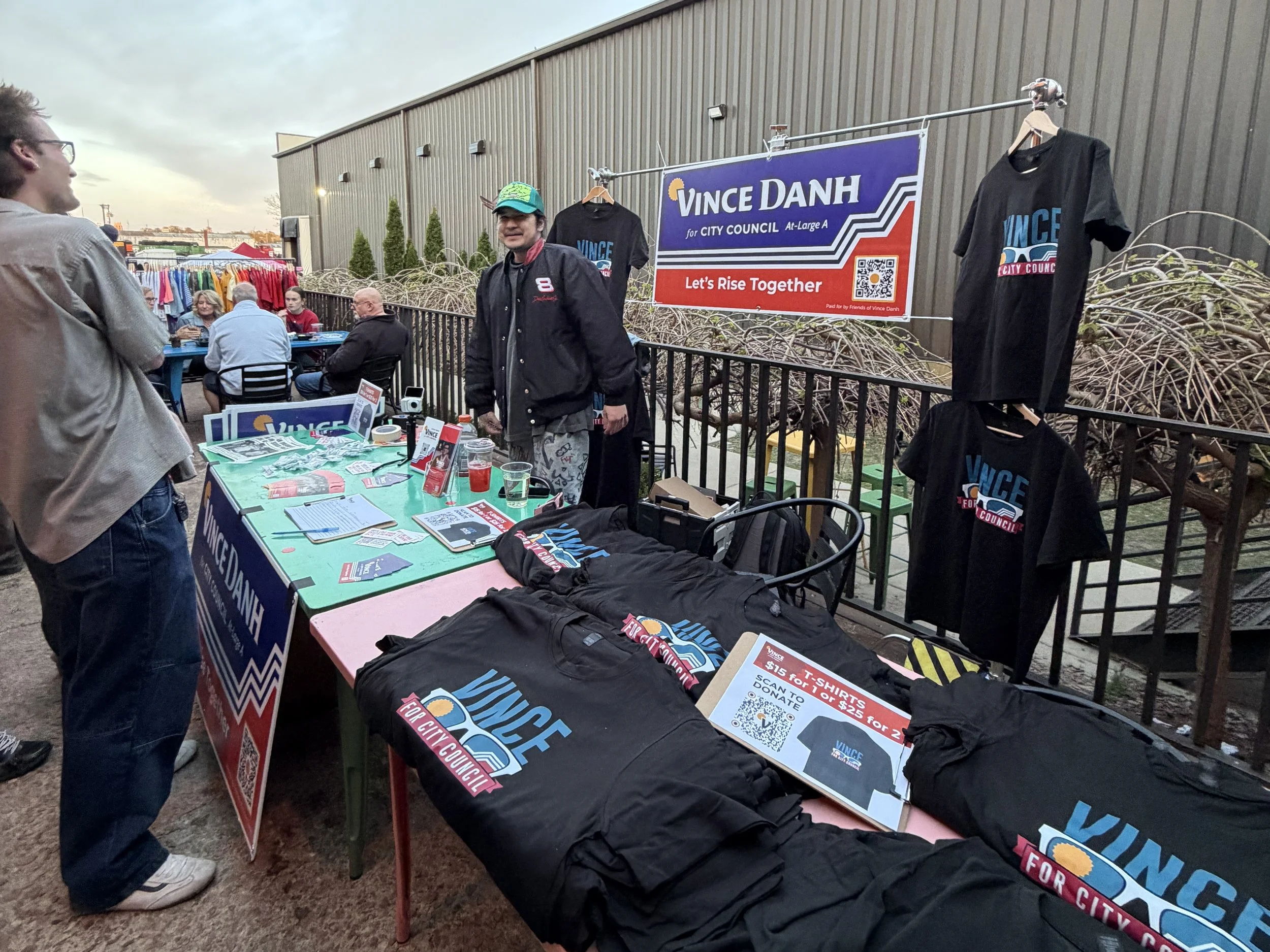
I've been to the Second Saturday Market before. Walked the floor, talked to vendors, watched the crowd. I thought I understood what it was. Then we got a booth — and I understood it differently.
There's a difference between showing up to something and setting up inside it.
I've been to the Second Saturday Market since the beginning. I've walked the floor, talked to vendors, watched the crowd move. I thought I understood what it was.
Then we got a booth. And I understood it differently.
The Room Was Working
By 7:00 PM, 8th & Railroad was full. Not politely full — actually full. The kind of full where you have to turn sideways to move between tables and every vendor is mid-conversation with someone who genuinely wants to know their story.
Across from us, a couple with a microgreens startup — bright trays of product, a handwritten sign, the kind of quiet confidence that comes from believing in something you grew yourself. Nearby, a family running a snacks business that's clearly outgrown the kitchen and is figuring out what comes next. A few tables down, a man with a hot sauce company — he told me he's disabled, that starting this business wasn't the easy path, and that the market gave him a table when a lot of other doors hadn't opened yet. And woven throughout, the vintage curators — racks of carefully sourced finds, the ones who know that fashion has memory and that someone in this room is looking for exactly what they brought.
None of them were there because a committee approved their application. They were there because they showed up.
That energy is hard to manufacture. Most cities spend a lot of money trying. Here it just exists.
The Moment Someone Knows You From a Screen
It happened a few times that night.
Someone would walk up to the booth, look at the sign, then look at me — and their face would shift. Oh. You're actually here.
We'd talked on Instagram. They'd seen a reel. They'd read something. But they'd never had a conversation in person. And what struck me every time was how quickly those conversations went somewhere real.
One woman told me she'd been following the campaign but wasn't sure politics was something she cared about. By the end she was talking about her neighborhood, a crosswalk that didn't feel safe, and whether the city would ever listen to someone like her.
That's not a campaign conversation. That's a person who needed to be heard. The market gave us the same table to sit at.
What "Representation" Really Means
I had a conversation that night that I keep coming back to.
A young vendor asked me what I meant when I talked about representation. Was it racial? Cultural? I said yes, but not only that.
Because the Second Saturday Market itself is a kind of answer to that question. Look around any given night and you'll see people who make very different amounts of money. People who got into business through very different doors — or had to find a window when the door was closed. People who create in different forms, sell different things, carry different stories about what work and community and ambition look like.
The couple with the microgreens is building something from the ground up. The family with the snacks business is figuring out how to scale. The man with the hot sauce didn't wait for someone to clear a path — he made one. The vintage curators are preserving something most people walk past.
That's representation too. Diversity of thought. Diversity of craft. Diversity of economic starting point. The market doesn't flatten those differences — it puts them in the same room and lets them talk.
A city that only makes room for one kind of creator, one kind of entrepreneur, one kind of neighbor — isn't really making room. It's just redecorating the same table for the same people.
This Is the Energy Sioux Falls Needs to Embrace
This is what a Vibrant Community actually looks like. Not a ribbon cutting. Not a press release. A building full of people on a Saturday night who are too busy building something to wait for permission.
Sioux Falls is growing fast. And in that growth, there's a real risk that we optimize for the familiar — the institutions we already know, the formats we already trust, the voices that already know how to navigate the system. Nights like this are a reminder of what gets lost when we do that.
Young people. First-time entrepreneurs. Artists who don't fit a category. Families testing an idea on a Saturday night before they can afford a storefront.
This city needs to do more than acknowledge that energy. It needs to build toward it.
That means permits that don't punish people for starting small. Micro-grants that reach makers before they're "established." A city that sees the Second Saturday Market not as a fun monthly event — but as a signal of who Sioux Falls is becoming.
We'll be back. Come find us.
It's always been our city, and now is our moment.
Let's rise together. ☀️
— Vince Danh
Candidate, Sioux Falls City Council At-Large | June 2nd, 2026